
Supply Halt, Rising Risks: The Silent Crisis in Bangladesh’s Family Planning System
A quiet crisis is unfolding across Bangladesh—one that does not make daily headlines but is already reshaping lives. In hundreds of upazilas, the absence of basic contraceptives is forcing thousands of women into uncertainty. For a country long celebrated for its family planning success, this moment raises an uncomfortable question: Is Bangladesh moving backwards in Sexual and Reproductive Health and Rights (SRHR)?
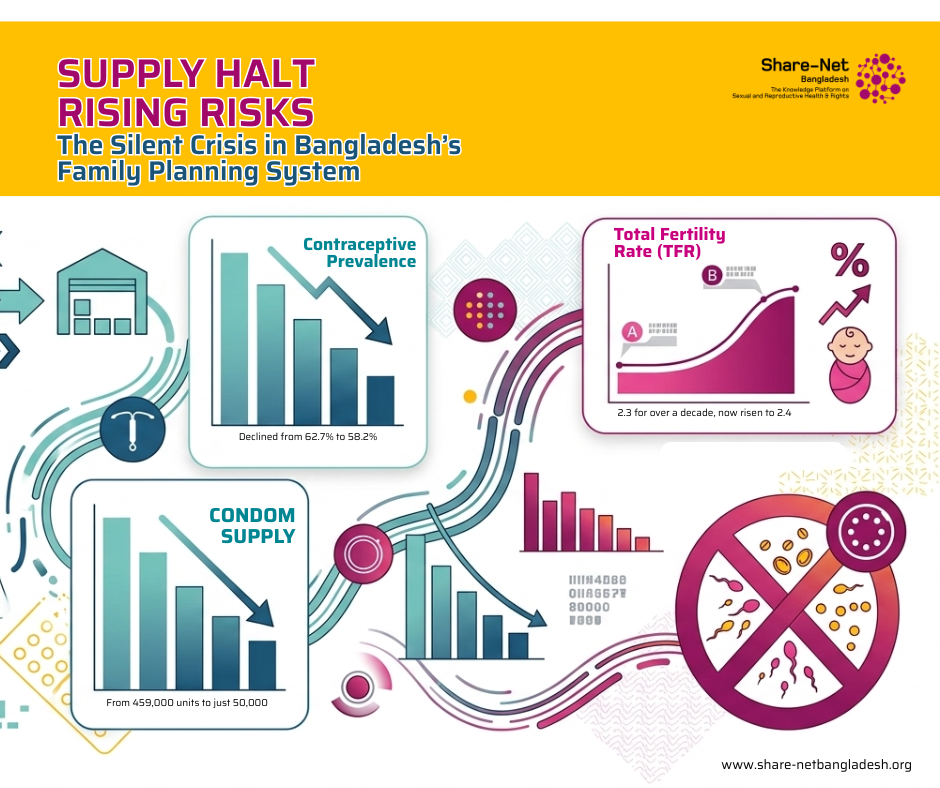
Recent data from the Directorate General of Family Planning (DGFP) paints a stark picture. Condoms are unavailable in 394 upazilas, oral pills in 335, and IUDs in 395. Implants are entirely out of stock nationwide. Distribution has collapsed dramatically; condoms dropped from 459,000 units to just 50,000 within a year.
At the core of this crisis lies a systemic disruption. Procurement has been stalled since July 2024, following the halt of the Health, Population and Nutrition Sector Program (HPNSP). The withdrawal of government engagement in the programme has fractured supply chains, leaving frontline services critically weakened.
The implications for SRHR are immediate and severe. Access to contraceptives is not just a service; it is a fundamental reproductive right. Without it, unintended pregnancies rise, maternal health risks increase, and progress in gender equality slows.
Field-level insights confirm this reality. “We have received less than 10% of the demand… supplies have been almost non-existent,” said a family planning officer from Satkhira. Another warning is even more striking: “When implants expire, we can remove them but cannot offer alternatives, leaving women unprotected.”
This gap between service provision and actual access is eroding trust. Community health workers, once the backbone of Bangladesh’s family planning success, now struggle to maintain credibility without supplies.
The data reflects a worrying trend. Bangladesh’s Total Fertility Rate (TFR), stable at 2.3 for over a decade, has now risen to 2.4 (MICS 2025). Contraceptive prevalence has declined from 62.7% to 58.2%. At the same time, the unmet need for family planning is increasing—moving the country further away from its 2030 targets.
Experts warn that the burden will fall disproportionately on low-income and vulnerable populations. Without free or affordable contraceptives, many cannot turn to private markets. This increases not only unintended pregnancies but also adolescent pregnancies, unsafe abortions, and sexually transmitted infections.
From an SRHR perspective, this is a regression. Bangladesh’s achievements, reducing fertility from over six children per woman at independence to near replacement level, were built on consistent access, strong outreach, and policy commitment. Disrupting any one of these pillars risks reversing decades of progress.
There are signs of a response. Authorities indicate that emergency procurement is underway, with partial supplies expected. However, restoring normalcy will take time, and more importantly, systemic resilience.
The crisis highlights a critical lesson: SRHR systems cannot depend on fragile supply chains or intermittent policy attention. Sustained investment, diversified procurement strategies, and community-based distribution innovations are essential.
Because at its core, this is not just a supply issue; it is about rights, dignity, and choice. And unless addressed urgently, the cost will be measured not only in statistics, but in lives quietly altered.
